
Most EHS managers know their ETP sludge is hazardous waste. Fewer can say, without opening a file, which rule sets their storage limit, which form goes with every truck, and when the annual return is due.
This checklist covers the ETP sludge hazardous waste rules in the order a plant actually meets them: classification, authorisation, storage, transport, returns and disposal. It is based on the Hazardous and Other Wastes (Management and Transboundary Movement) Rules, 2016, as amended, with notes on how the Gujarat Pollution Control Board (GPCB) handles the paperwork online.
1. Is your ETP sludge hazardous?
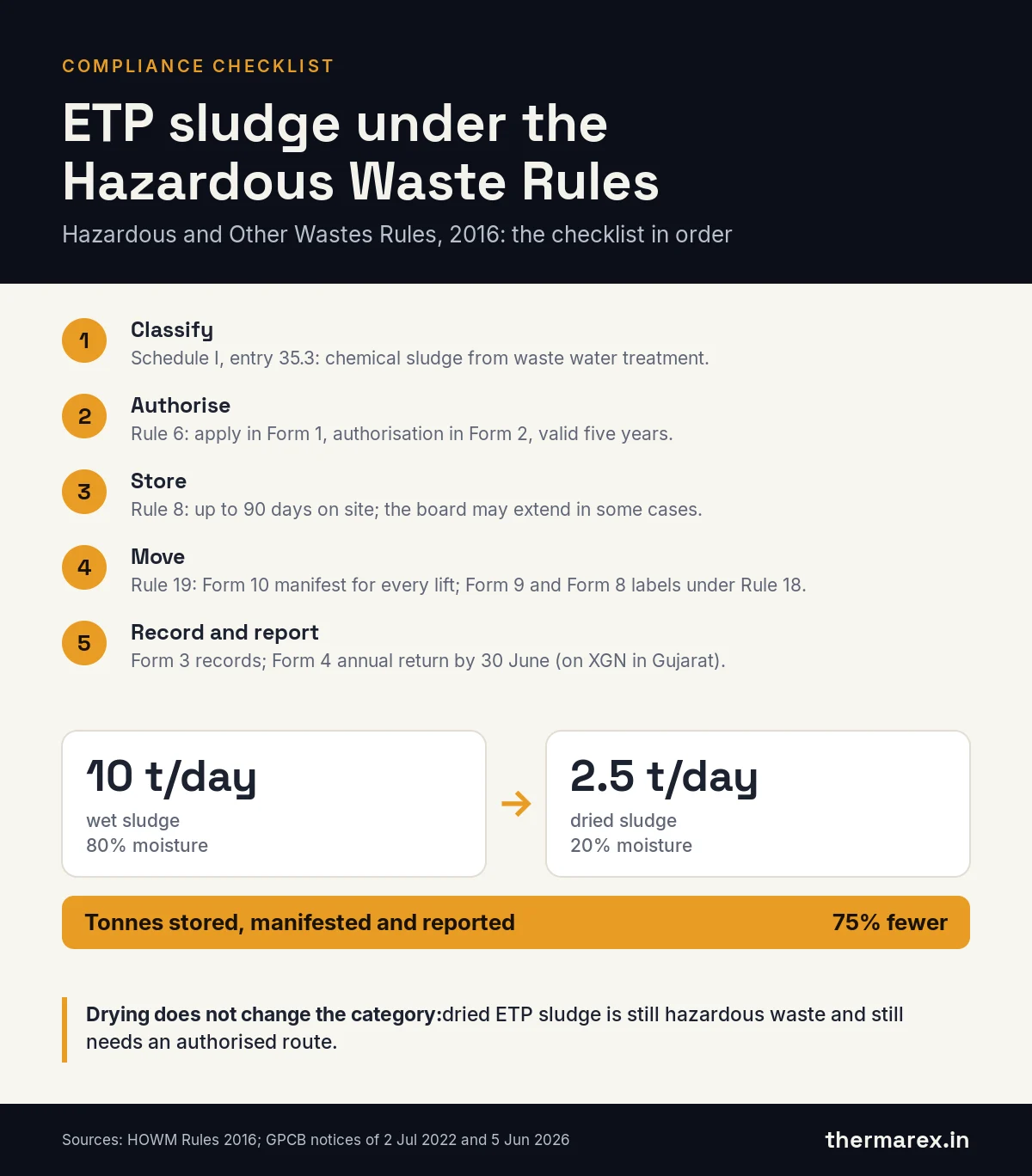
Almost certainly. Schedule I of the 2016 Rules lists the processes that generate hazardous waste. Under process 35, the purification and treatment of exhaust air, water and wastewater (including common effluent treatment plants), waste entry 35.3 is “chemical sludge from waste water treatment”.
A waste can also be hazardous under Schedule II, if it contains listed constituents above their concentration limits or shows a listed hazardous characteristic. Many industries have their own Schedule I entries for process sludges too, so check both your industry entry and 35.3.
- Confirm the Schedule I entry (or entries) for your sludge in your authorisation.
- Keep a recent analysis report, since the TSDF or co-processor will ask for one.
- If you change your process or chemicals, re-test before assuming the classification still holds.
2. Authorisation: Form 1 in, Form 2 out
Rule 6 requires every occupier generating hazardous waste to apply to the State Pollution Control Board in Form 1 and obtain an authorisation. The board grants it in Form 2, valid for five years, with conditions.
- Check that the authorised quantity covers your real sludge generation, in tonnes a year.
- Check the disposal routes named in the authorisation match what you actually use.
- Diary the renewal date well ahead of expiry.
Rule 4 also sets the order you are expected to follow: prevention, minimisation, reuse, recycling, recovery and utilisation (including co-processing), and only then safe disposal. Reducing what you generate is part of the duty.
3. Storage limits and time on site
Rule 8 allows an occupier to store hazardous waste for a period not exceeding ninety days, with records of sale, transfer, storage and disposal kept. The state board can extend this, up to 180 days for small generators and in some other cases, based on annual quantity.
- Store sludge in a covered, impervious area with leachate collection, as your authorisation and consent conditions specify.
- Label containers as Rule 18 requires (Form 8).
- Track the date each batch went into storage, not just the total tonnage.
The 90-day clock is where wet sludge causes most trouble. When TSDF slots are delayed or trucks stop running in the monsoon, a shed full of wet cake fills up quickly.
4. Manifests and transport
Every movement of hazardous waste needs a manifest. Under Rule 19, the sender prepares the manifest in Form 10, seven copies, signed. The transporter also needs hazard information from you in Form 9 (Rule 18).
In Gujarat, GPCB runs an online manifest system. Its notice of 2 July 2022 said units sending waste to an authorised facility inside Gujarat need not deposit a physical copy of the online manifest with the board, while waste disposed of in another state still needs a physical copy deposited after final disposal.
- Generate the manifest before the truck leaves, and check the quantity against your weighbridge slip.
- Use only a transporter and a receiving facility authorised for your waste category.
- Keep the returned copy that confirms receipt at the facility.
5. Records and the annual return
Keep a running record of the waste you generate and manage in Form 3 (Rules 6 and 20). The annual return goes to the state board in Form 4 by 30 June for the previous financial year.
In Gujarat, GPCB’s notification of 5 June 2026 ended physical submission for a list of documents, including the annual return in Form 4 (Form-IV in GPCB’s list) under the Hazardous Waste Rules. It must now be uploaded on the XGN portal, and the upload time counts as the submission date.
- Reconcile Form 3 totals with your manifests every month, not once a year.
- Upload Form 4 on XGN before 30 June.
- Report any accident involving hazardous waste to the board immediately, followed by a report in Form 11 (Rule 22).
6. Where drying fits within the ETP sludge hazardous waste rules
Drying does not change the classification. Dried ETP sludge is still the same hazardous waste and still needs authorisation, manifests and an authorised disposal route. What drying changes is the quantity you handle under every one of those rules.
Take 10 tonnes a day of sludge at 80% moisture. It holds 2 tonnes of dry solids. Dried to 20% moisture, those solids weigh 2.5 tonnes, a 75% cut in the tonnes you store, manifest, truck and report. At our Bhilosa Industries plant, ETP sludge at about 80% moisture is dried to 10% or less in an automated solar sludge dryer.
Fewer tonnes mean more days of storage in the same shed before the 90-day limit bites. You also see fewer truck movements and manifests, and smaller figures in Form 3 and Form 4. Drying also counts as minimisation in the Rule 4 order, and dried sludge is better suited to co-processing in cement kilns, which sits above landfill in that order. Drying works within the ETP sludge hazardous waste rules, not around them. Before you install a dryer, check with your board whether your authorisation or consent needs amending.
For what happens after the sludge leaves your gate, our sludge recycling and disposal services cover that side.
Running close to your storage limit? Send us your monthly sludge tonnage and moisture, and we will show you how much a dryer would take off your stored and manifested tonnes.
Talk to us about cutting stored tonnageFrequently asked questions
Is ETP sludge hazardous waste in India?
Generally yes. Chemical sludge from wastewater treatment is listed as entry 35.3 in Schedule I of the Hazardous and Other Wastes Rules, 2016.
How long can hazardous ETP sludge be stored on site?
Up to ninety days under Rule 8. The state pollution control board can extend this in some cases, up to 180 days for small generators.
Which form is the hazardous waste manifest?
Form 10, prepared by the sender under Rule 19. In Gujarat, manifests are generated on GPCB’s online system.
When is the hazardous waste annual return due?
Form 4 is due by 30 June for the previous financial year. In Gujarat it must be uploaded on the XGN portal.
Does drying ETP sludge make it non-hazardous?
No. Dried sludge keeps its classification. Drying reduces the tonnes you store, transport and report, not the category of the waste.
Sources: Hazardous and Other Wastes (Management and Transboundary Movement) Rules, 2016; GPCB notice on online manifests, 2 July 2022 (summary); GPCB notification on XGN online submission, 5 June 2026 (summary); Thermarex Bhilosa Industries case study.
