
Your filter press drops out sludge that is still about four-fifths water, and every truck that leaves the gate is mostly carrying that water. This guide explains how a solar sludge dryer works, by following one tonne of that sludge from the day it arrives in the greenhouse to the day it leaves as dry, crumbly granules.
We design and build these plants at Thermarex, so this is the engineer’s view. We cover what each part does and why it is there, with the numbers alongside.
What goes in and what comes out
A solar dryer takes dewatered sludge, the cake from a filter press, screw press or centrifuge, and removes most of the remaining water using the sun. The dry solids stay; only water leaves.
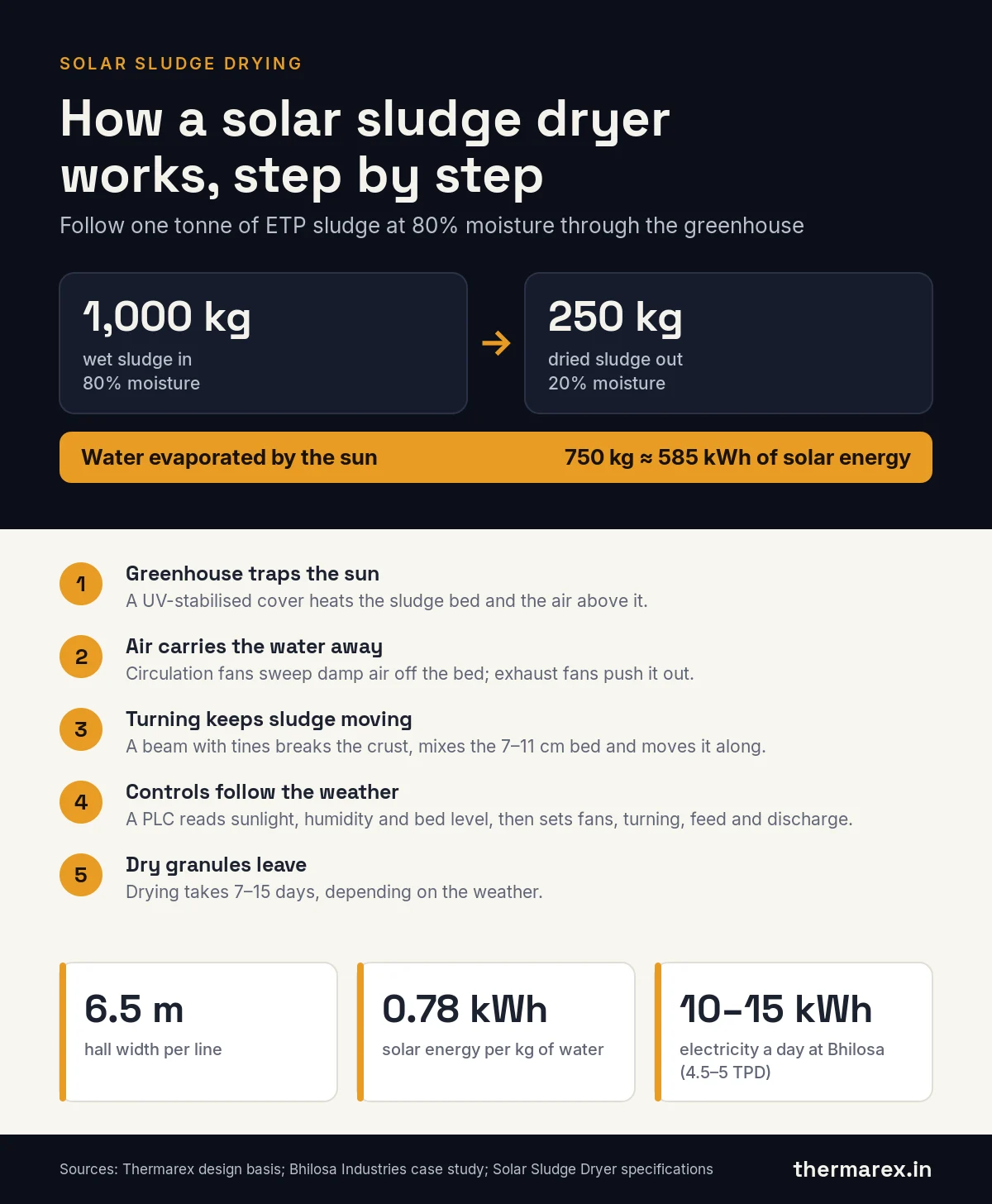
Take one tonne of ETP sludge at 80% moisture:
- Dry solids: 1,000 × 0.20 = 200 kg
- Dried to 20% moisture, those 200 kg of solids weigh 200 ÷ 0.80 = 250 kg
- Water evaporated: 1,000 − 250 = 750 kg
So three-quarters of what came in leaves as water vapour, and a quarter leaves as dried sludge. At our Bhilosa Industries plant in Silvassa the dryer was designed for below 20% moisture and has achieved 10% or less. Our published range for the Solar Sludge Dryer is final dry solids of up to about 90%, depending on the sludge and the climate.
That 750 kg of water is the real job. Everything inside the plant exists to evaporate it and carry it away.
Step 1: the greenhouse traps the sun
The building is a greenhouse: a galvanised steel frame with a UV-stabilised transparent cover. Sunlight passes through the cover and heats the sludge bed and the air above it. The heat stays inside, so the hall runs warmer than the air outside, and warm air holds more moisture.
Evaporation takes a lot of energy. In our design basis we allow about 0.78 kWh of solar energy for every kilogram of water evaporated. For the tonne above, that is 750 kg × 0.78 = about 585 kWh, all of it supplied by the sun rather than by a burner or boiler.
This is why area matters. A solar dryer collects energy over its floor, so the drying area is set by how much water you need to remove and how much sunshine your site gets in its weakest months. Our halls are 6.5 m wide per line, and the length is what we size.
Step 2: air carries the water away
Heat alone is not enough. If the air above the sludge stays still, it soon becomes saturated and drying stops, even on a sunny day. So the dryer moves air in two ways.
Circulation fans keep air moving across the bed, so the layer of damp air sitting on the sludge surface is swept off and replaced with drier air. Exhaust fans then push the moist air out of the hall and draw fresh air in.
The exhaust only helps when the air inside is more humid than the air outside. On a dry winter afternoon in Gujarat, every cubic metre pushed out takes a lot of water with it. On a humid monsoon morning the difference is small, and running the fans hard gains little. A good control system knows the difference; we come to that in step 4.
Step 3: the turning machine keeps the sludge moving
Left alone, sludge dries from the top down. The surface forms a crust, which seals in the wet layer underneath, and drying slows to a crawl. Biological sludge can also go anaerobic and start to smell.
The turning machine prevents this. In our plants it is a beam that spans the 6.5 m hall and travels along its length, with tines that dig into the bed, break the crust, mix wet sludge up to the surface and loosen it so air can get in. Each pass also moves the sludge a little further along the hall, from the feed end towards the discharge end. One 4 kW drive runs the turning system on each line.
The bed is kept shallow. For ETP chemical sludge we work with a bed of about 7 to 11 cm. Thicker than that, and the bottom layer does not see enough air; thinner, and you waste floor area.
Turning also changes the product. Instead of a cracked slab, you get a loose, granular product that is easy to load and handle.
Step 4: the controls decide when to turn and vent
A solar dryer works with the weather, and the weather changes by the hour. The plant is run by a PLC with an HMI screen, reading a handful of sensors:
- temperature and humidity inside the hall
- temperature and humidity outside
- a pyranometer measuring sunlight
- the level of the sludge bed
- motor currents on the drives
From these readings the controller works out how good the drying conditions are at that moment. When the air inside is much wetter than outside, it speeds up the exhaust fans. When the gap closes, it slows them, because there is no point paying for power that moves air without removing water. Turning speed, the feed rate and the discharge rate are adjusted together, so that sludge spends longer in the hall when drying is slow and moves through faster when conditions are good.
The controls also watch the machines. A sudden change in motor current on the turner can mean a broken tine or an obstruction, and the operator is alerted before it becomes a breakdown.
Step 5: feeding and discharge
The last step is the simplest part of how a solar sludge dryer works: getting sludge in and out.
Wet cake is spread at the feed end, and dried granules are collected at the discharge end and conveyed to storage or straight into bags or trucks. Feeding and discharge layouts are adapted to each site, depending on where the dewatering unit sits and how the dried sludge leaves.
Our published drying time is 7 to 15 days, depending on the weather. Plants can be built from 0.5 to 100 TPD of wet sludge.
How a solar sludge dryer works through a day
Early in the morning the hall is cool and the air inside is close to saturated from the night. As the sun comes up, the pyranometer reading rises, the hall warms, and the humidity inside climbs above the humidity outside. The fans speed up and begin pulling water out.
Through the middle of the day drying is at its best. The turner works the bed, the exhaust runs, and the sludge at the discharge end reaches its target dryness. By late afternoon sunlight drops, the controller eases off the fans, and at night the plant mostly rests.
Electricity use is small because the sun does the evaporating and the motors only move air and sludge. At Bhilosa, a 4.5 to 5 TPD automated solar dryer on about 940 m² uses around 10 to 15 kWh a day, roughly 300 units a month.
The monsoon is the test of a design. With high humidity and cloud for weeks, the plant dries less sludge than arrives. We size halls using 10 years of monthly sunshine data from NASA POWER and design to the P90 case, the level of sunshine you can count on in nine years out of ten. We also plan a staging area to hold the monsoon backlog until the dry season catches up.
Where a solar dryer fits, and where it doesn’t
Solar drying suits plants that have land, generate a steady flow of dewatered sludge and are in a sunny region, which covers most of western and southern India. It is used for municipal STP sludge, industrial ETP sludge, paper mills and food processing.
When land is short, or the sludge volume is very large, we combine solar with a thermal stage. At the NTIEM CETP in Ahmedabad, handling 160 to 200 TPD of textile sludge, a hybrid of solar and a multi-layer mesh belt dryer using waste heat reaches up to 85 to 90% dry solids. For sludge that needs to be stabilised biologically before use, our Bio-Tunnel System is the other route.
Want to see one running? Tell us your sludge type, tonnage and location, and we will show you how the dryer would be laid out for your site, or arrange a visit to a working plant.
Request a site visitFrequently asked questions
How long does sludge take to dry in a solar dryer?
Typically 7 to 15 days, depending on the weather, the sludge and the target dryness. Drying is faster in the dry season and slower in the monsoon.
How dry can a solar sludge dryer get the sludge?
Up to about 90% dry solids, depending on the feed and the climate. At Bhilosa, sludge at about 80% moisture is dried to 10% moisture or less.
How much electricity does a solar sludge dryer use?
Little, because the sun supplies the heat. Power goes to fans and the turning machine. Our Bhilosa plant, handling 4.5 to 5 TPD, uses around 10 to 15 kWh a day.
Does a solar sludge dryer work in the monsoon?
Yes, but more slowly. We size the hall for P90 sunshine from 10 years of data and provide a staging area for the monsoon backlog.
Why does the sludge need turning?
Turning breaks the surface crust, brings wet sludge to the top, lets air into the bed, prevents odour and moves the sludge along the hall towards discharge.
How much land does a solar dryer need?
It depends on tonnage, moisture and local sunshine. For reference, our Bhilosa plant dries 4.5 to 5 TPD on about 940 m². We size each plant from your site’s weather data.
Sources: Thermarex design basis and installed-plant data (Bhilosa Industries, NTIEM CETP case studies; Solar Sludge Dryer specifications); NASA POWER solar data.
