
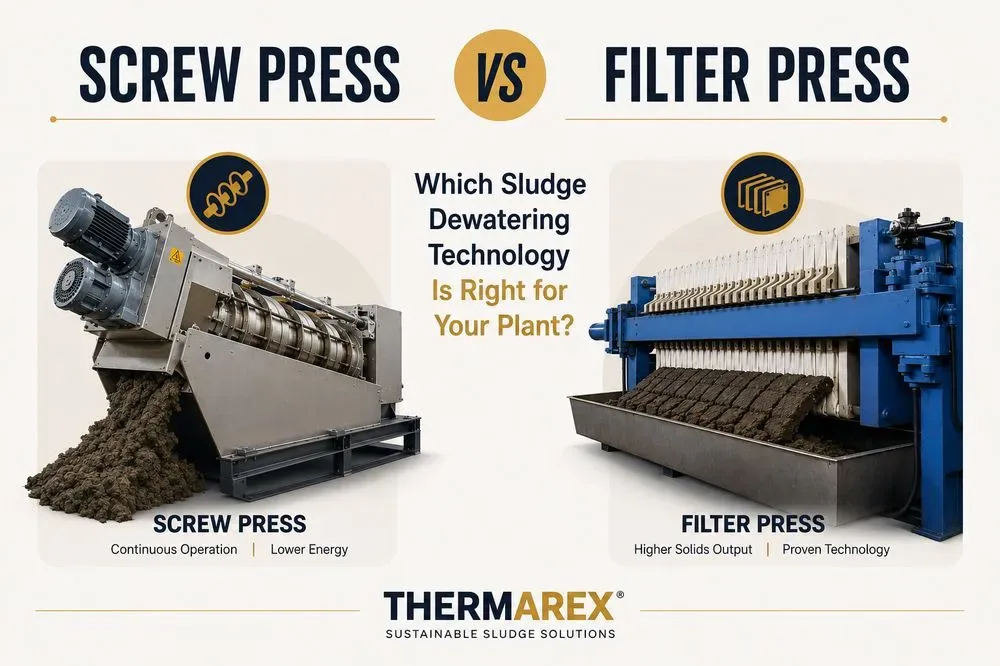
Choosing between a screw press vs filter press for sludge dewatering is a decision you live with for ten years or more. Pick the wrong one and you pay for it every month, in polymer, power, operator hours, maintenance and the tonnes of wet cake you send to a TSDF or co-processing plant.
Most equipment decisions still come down to the lowest quote, what the neighbouring plant bought, or the supplier’s advice. None of these tells you whether a machine suits your sludge. Both technologies are proven and both work well across industries, but they are built for different sludges, operating patterns and plant priorities. There is no universally better machine. The right one is whichever gives the lowest total sludge management cost for your application.
This guide compares the two from an engineering point of view, brings in the decanter centrifuge as the third common option, and ends with a practical framework and decision tree.
A note on our interest: Thermarex supplies a multi disk screw press, so we have a stake in one side of this comparison. We have tried to keep it fair. Where a filter press is the better fit, we say so, and the performance figures below come from published sources, not from our brochure.
If you want the bigger picture first, our industrial sludge management guide shows where dewatering sits in the full treatment and disposal chain.
Start with the objective, not the machine
The most common question buyers ask is “which machine gives the driest sludge?” Cake dryness matters, but it is one part of the economics. A slightly drier cake may not justify more labour, more maintenance, longer cycles, higher energy use or a larger capital outlay. Equally, a machine chosen only for low running cost can raise transport and disposal bills if the cake stays too wet.
A better question is: which technology gives the lowest total cost of handling and disposing of this sludge over the life of the plant? That question changes how you write the specification, how you compare quotes and how you run trials.
What mechanical dewatering can and cannot do
Mechanical dewatering removes free water from sludge using pressure, gravity or centrifugal force. It does not remove all moisture. Water held inside flocs, cells and particles (bound water) stays in the cake, and taking it out needs thermal or solar drying.
This explains a lot of disappointed buyers. A plant expects a press to deliver a cake that only a dryer can produce. Our own drying projects show the gap. At Bhilosa Industries in Silvassa, the dewatered ETP sludge still arrived at about 80% moisture. It took a solar sludge dryer to bring it down to 10% or below.
What is a screw press?
A screw press is a continuous dewatering machine. A slowly rotating screw pushes conditioned sludge along a cylindrical screen (or, in a multi disk design, through a stack of fixed and moving rings). The gap between the screw flights narrows towards the outlet, so pressure rises gradually. Water escapes through the screen and dewatered cake leaves at the far end.
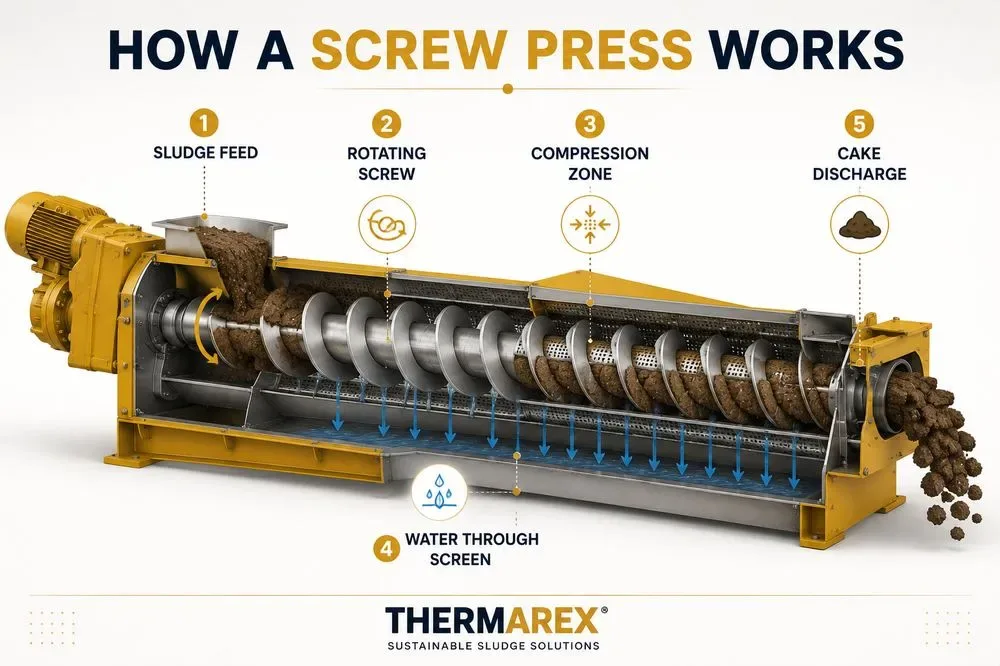
- Sludge feed: polymer-conditioned sludge enters the feed zone.
- Rotating screw: the screw moves the sludge forward slowly.
- Compression zone: the space between flights shrinks and pressure increases.
- Water through screen: filtrate drains through the screen or disk gaps.
- Cake discharge: dewatered cake leaves continuously.
Where screw presses do well
- Continuous operation: it runs with the plant, so it suits steady sludge production and 24-hour operation.
- Low energy use: the screw turns slowly, so drive power is small compared with high-speed machines such as decanter centrifuges.
- Small footprint and simple enclosure: useful in existing ETPs and STPs where space is tight; an enclosed unit also keeps odour down.
- Little operator attention: once the polymer dose is set, operators monitor rather than run each cycle.
- Gentle handling: gradual compression suits biological sludge, which is why screw presses are common at municipal STPs and in food, dairy and beverage plants.
Published results give a fair idea. In a UK utility trial of a multi disk screw press, Anglian Water reported average cake of roughly 18–21% dry solids (DS) on surplus activated sludge. A mix with some raw primary sludge gave about 25% DS, and digested sludge 25–27.5% DS. On activated sludge it used about half the polymer of a centrifuge, because no separate thickening step was needed (Inman et al., Anglian Water). Our own multi screw press is rated at 20–22% outlet DS from a 0.2–5% DS feed, depending on sludge type and polymer dosing.
Limitations of screw presses
- Cake dryness depends heavily on the sludge. The same machine can do very well on one sludge and only moderately on another. Biological sludge typically stays in the high teens to low twenties of % DS.
- Polymer conditioning is critical. The wrong polymer or dose cuts performance sharply. Fixing conditioning costs far less than replacing equipment.
- Not every industrial sludge suits it. Highly abrasive, fine inorganic or chemically complex sludges may need pressure filtration or a centrifuge to reach the cake target.
A screw press should never be chosen just because it uses less electricity. Energy is one line in the lifecycle cost. Polymer, labour, maintenance, cake dryness and disposal often matter more.
What is a filter press?
A filter press (recessed-plate or membrane type) is a pressure-driven batch machine. Conditioned sludge is pumped into chambers formed between plates lined with filter cloth. Pressure pushes water through the cloth, solids build up as cake, and when the chambers are full the press opens and the cake drops out. Then the press closes and the next cycle starts.
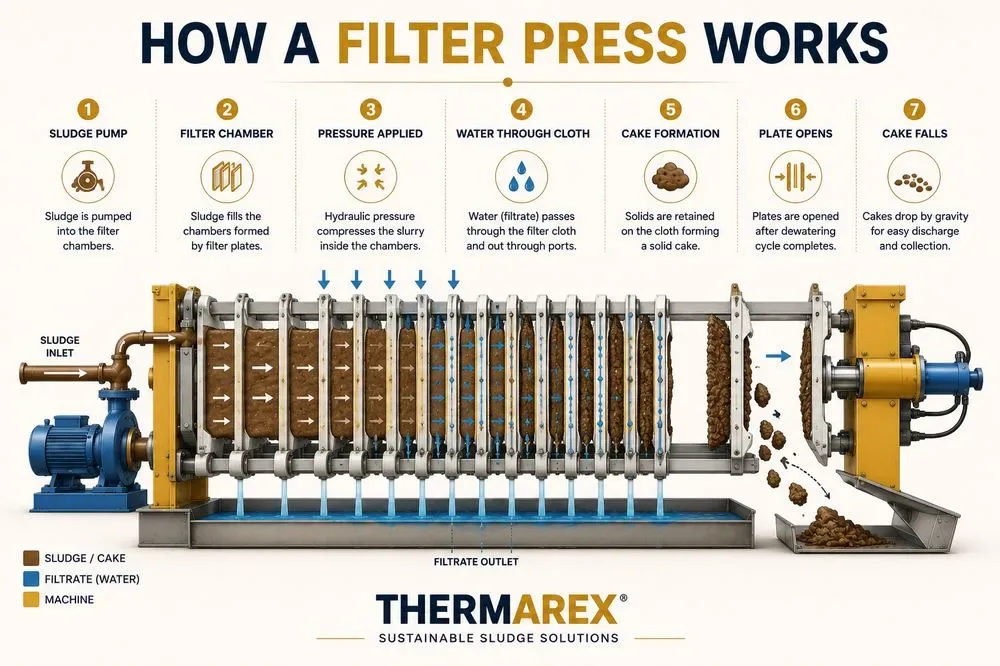
The US EPA’s fact sheet on recessed-plate filter presses describes them as producing the highest cake solids of any mechanical dewatering equipment. It notes that pressure filtration can take many types of solids above 30% solids. Cake ranges from 12–15% solids (custard-like) to 20–40% solids (moist soil), depending on the sludge and conditioning. Filtration cycles with lime and ferric chloride typically run one to three hours, and longer with polymer (US EPA, Recessed-Plate Filter Press fact sheet).
One caution on headline numbers: when lime and ferric chloride are used for conditioning, the EPA notes these chemicals can make up 15–40% of the cake solids. A high % DS figure can therefore include a lot of added chemical mass that you also pay to haul and dispose of.
Where filter presses do well
- Drier cake: the strongest case for a filter press, especially where disposal is charged per wet tonne.
- High solids capture: cleaner filtrate and fewer solids returned to the ETP.
- Difficult industrial sludges: chemical, electroplating, metal finishing, mining and other inorganic sludges often dewater well under high pressure.
Limitations of filter presses
- Batch operation: the press must be filled, opened, emptied and closed every cycle.
- Labour: the EPA lists cloth preparation, cleaning and cake removal as potentially operator-intensive, even though the pressing phase itself needs little attention. Automatic plate shifters and cloth washers reduce, but do not remove, this work.
- Capital and space: the EPA describes capital cost as relatively high and the space requirement as relatively large.
- Odour: the press cannot be fully enclosed, so operators are exposed when the cake is released.
Higher cake dryness does not automatically mean lower total cost. The extra labour, cloth replacement, longer cycles and higher capital can outweigh the disposal saving.
Screw press vs filter press: the engineering comparison
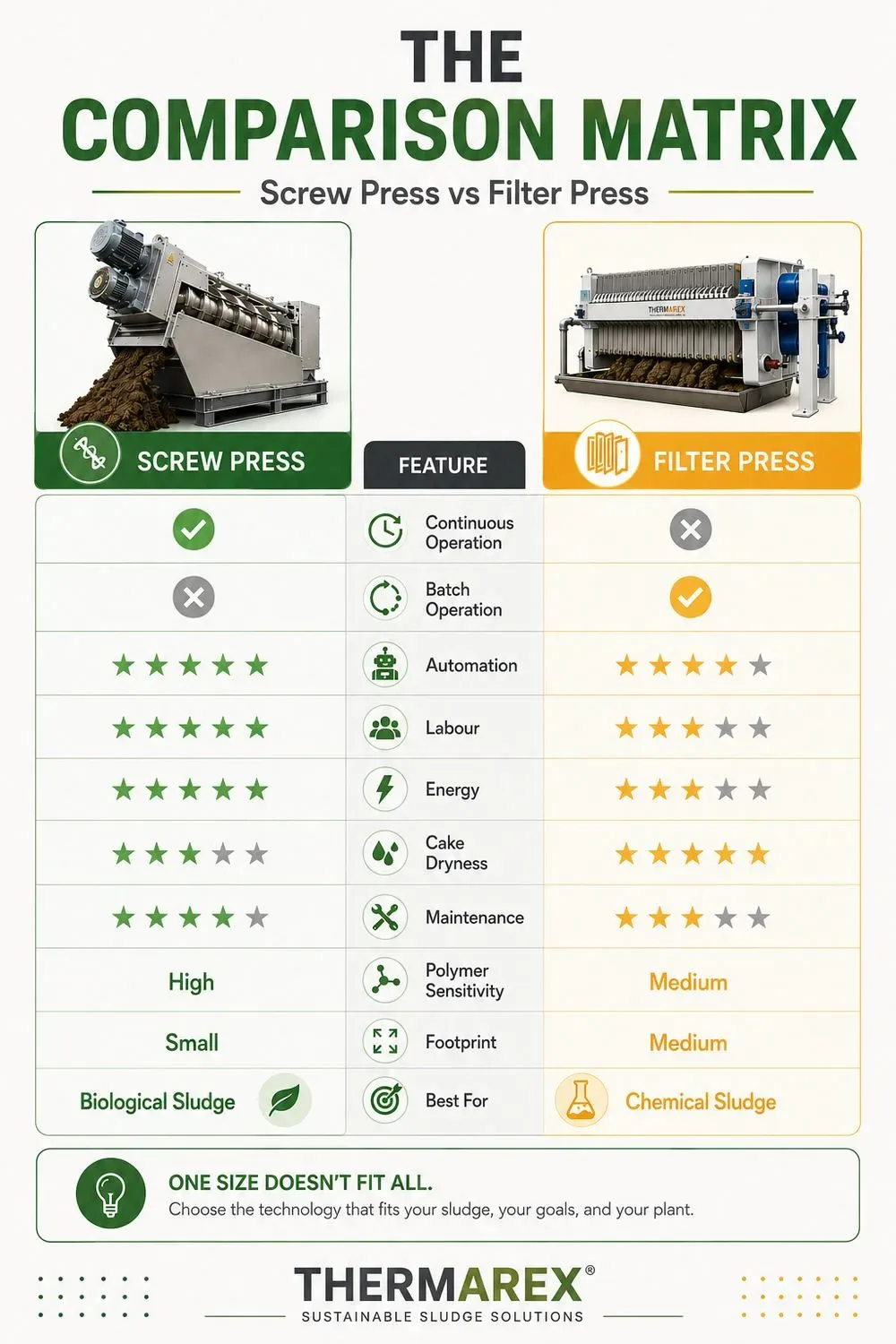
The table below brings the main differences into one place and adds the decanter centrifuge, the third technology most plants shortlist. The centrifuge figures are from the US EPA centrifuge thickening and dewatering fact sheet. None of the sources gives reliable kWh per tonne figures, so energy is compared qualitatively.
| Factor | Screw press | Filter press | Decanter centrifuge |
|---|---|---|---|
| Operation | Continuous | Batch (fill, press, open, discharge) | Continuous |
| Typical cake solids (published) | About 18–21% DS on activated sludge, 25–27.5% on digested sludge (Anglian Water trial) | 20–40% solids typical; above 30% for many sludges (US EPA) | 16–25% on undigested waste activated sludge, 25–40% on undigested primary (US EPA) |
| Energy use | Low (slow screw) | Moderate (feed pump, hydraulics, cycling) | High (EPA: “high power consumption”) |
| Operator attention | Low once the polymer dose is stable | Moderate to high at cake discharge and cloth cleaning | Low when stable, but needs experienced operators to optimise |
| Polymer sensitivity | High | Medium (often lime/ferric conditioned) | High |
| Footprint | Small | Relatively large | Small for its capacity |
| Main maintenance items | Screen or disks, screw wear, bearings, lubrication | Filter cloths, plates, seals, hydraulics | Bowl and scroll wear, expensive spares, often serviced by the maker |
| Capital cost | Generally lower | Relatively high (EPA) | Varies with size; spares are costly |
| Noise and odour | Quiet, can be enclosed | Odour at cake release | Fairly noisy (EPA) |
| Best fit | Biological sludge, continuous plants, small operator teams | Chemical and inorganic sludge, high disposal cost per tonne | Large plants with limited space and skilled operators |
Continuous or batch: does it match your process?
Plants that produce sludge round the clock usually prefer a machine that runs with them. Stopping every few hours to discharge cake is awkward when the ETP never stops. Plants that generate sludge in batches, or run one or two shifts, often find a batch press perfectly workable.
Cake dryness: what decides it
Cake dryness is the first thing buyers compare and the most misunderstood. The machine does not set it alone. Sludge type, feed solids, polymer conditioning, operator settings and equipment condition all play a part. Waste activated sludge dewaters poorly on any machine; primary and inorganic sludges dewater much better.
If two vendors promise very different cake solids for the same sludge, ask for a pilot trial on your sludge. Laboratory and pilot data are more reliable than brochure figures. If your current press is underperforming, our guide to sludge dewatering problems covers the common causes and how to diagnose them.
Polymer: the hidden running cost
Polymer is often left out of equipment evaluation because it is booked as a consumable. Over a year it can be one of the largest operating costs. Neither technology automatically uses less: consumption depends on the sludge, the conditioning set-up, polymer chemistry and how well the dose is optimised. Compare annual polymer cost from trials, not the dose quoted on a datasheet.
Labour, maintenance and space
A screw press typically needs routine inspection and periodic screen or disk cleaning, which suits remote plants and small teams. A filter press adds cycle monitoring, plate and cloth inspection, cloth washing and cake handling. Modern automatic presses reduce manual work but generally still need more involvement than a screw press.
Neither machine is maintenance-free. The useful question is whether your maintenance team can support it, and whether spares are available locally. For footprint, look beyond catalogue dimensions: feed pumps, polymer preparation, cake conveyors, maintenance access and safety clearances often decide whether a machine fits.
Lifecycle cost: the comparison that matters
In a screw press vs filter press decision, the purchase order is the smallest part of the story. As a general pattern, a screw press tends to cost less to buy and run, while a filter press tends to produce less cake to dispose of. Which wins depends on the size of your disposal bill.
Simple arithmetic shows why. Take one tonne of dry solids, purely as an illustration. At 20% DS it leaves as 5 tonnes of wet cake. At 35% DS it leaves as about 2.9 tonnes. Where hazardous sludge goes to a TSDF or co-processing plant at a per-tonne rate, that difference can repay a more expensive press. Where disposal is cheap, or the cake goes on to a dryer anyway, it may not. Our article on industrial sludge disposal cost explains how those rates build up.
Compare the total cost of ownership, including:
- equipment, civil work and installation
- electricity and polymer
- operators and supervision
- maintenance, spares (cloths, screens, wear parts) and downtime
- transport and disposal of the wet cake
- room for future capacity
Which industries usually prefer which technology?
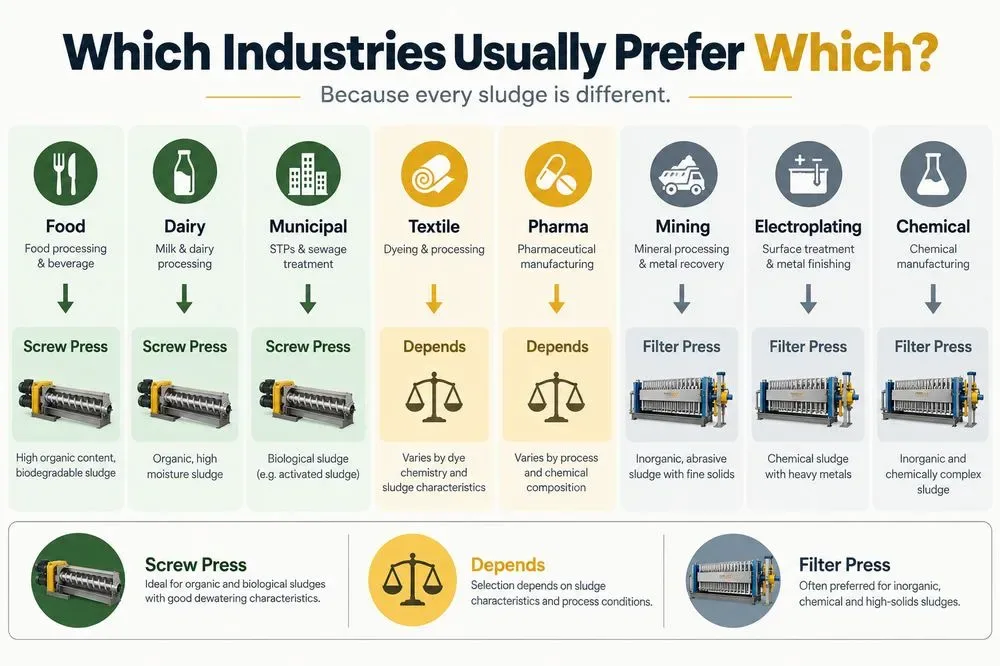
Some industries lean one way because of their sludge.
| Industry | Usual lean | Why |
|---|---|---|
| Food processing, dairy, breweries | Screw press | Organic, biological sludge produced continuously |
| Municipal STPs | Screw press (centrifuge at large plants) | Biological sludge, low labour, continuous operation |
| Textile, pharmaceutical, paper and pulp | Depends | Sludge varies with process chemistry, fibre content and treatment scheme |
| Chemical manufacturing | Filter press | Chemical precipitates; drier cake cuts hazardous waste disposal tonnage |
| Electroplating and metal finishing | Filter press | Inorganic, metal-rich sludge suits pressure filtration |
| Mining and minerals | Filter press | Dense mineral sludge with high solids loading |
Industry alone should never decide the choice. Two textile mills, or two pharma plants, can produce sludges that dewater completely differently.
Common purchasing mistakes
- Buying on the lowest quote. A low purchase price can be overtaken by operating cost within a few years.
- Copying another plant. A neighbour’s sludge may behave very differently from yours.
- Judging on cake dryness alone. The driest cake does not always give the lowest total cost.
- Ignoring maintenance capability. A sophisticated machine is only useful if your team can keep it running.
- Skipping the pilot trial. Trial data on your own sludge beats catalogue figures and vendor claims.
Our five-step equipment selection framework
Many dewatering projects disappoint because selection starts with machines instead of sludge. We use the opposite order.
Step 1: Understand your sludge
Before asking for quotes, establish the sludge type (primary, biological, chemical or mixed), feed solids and moisture, particle size, organic content, oil and grease, heavy metals, hazardous waste classification, daily quantity and seasonal swings. Our sludge characterisation guide explains which tests matter and why.
Step 2: Define the business objective
Decide what matters most for your plant: lowest operating cost, maximum automation, limited labour, rising disposal cost, restricted space, or growth in sludge volume over the next five years. These answers shape the choice more than any brochure.
Step 3: Check site constraints
Look at floor space, headroom, electrical capacity, polymer preparation area, cake storage, maintenance access, utilities and room for expansion. Projects get expensive when these are considered too late.
Step 4: Compare lifecycle cost
Ask which machine will cost less over ten years, not which is cheaper today. Use the cost list above, with polymer and cake solids taken from trials on your sludge.
Step 5: Validate with a pilot trial
Run the shortlisted technologies on your actual sludge and record cake solids, polymer consumption, throughput, power draw, filtrate quality and ease of operation. Base the final decision on that data.
Decision tree: which technology is right for your plant?
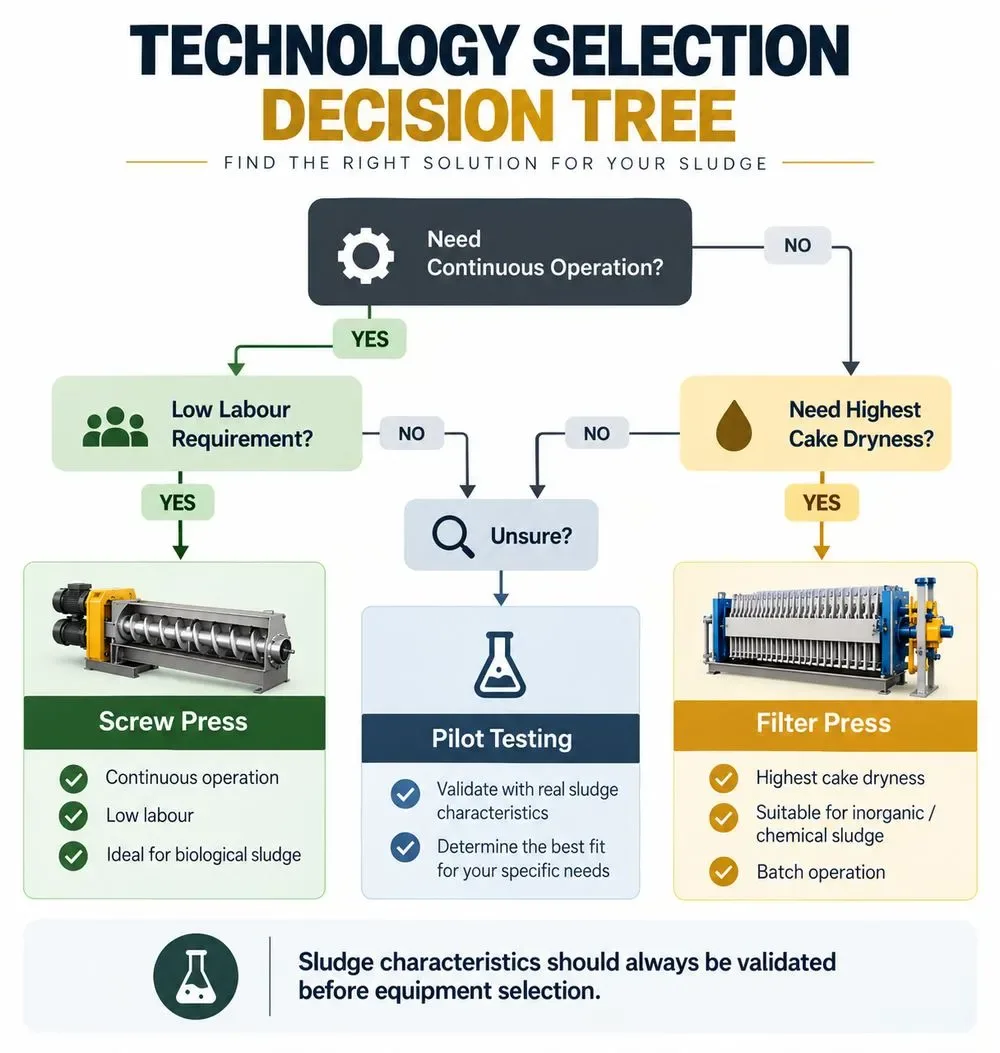
The decision tree reduces the screw press vs filter press question to a few honest answers about your plant. A screw press is usually the better fit when sludge is produced continuously, labour is limited, energy use matters, the sludge is mainly biological and space is tight. A filter press usually wins when a dry cake is essential, disposal dominates operating cost and the sludge is chemical or inorganic. Batch operation must be acceptable, and operators must be available for cycle management. A decanter centrifuge earns its place at larger plants that need high throughput in a small footprint and can accept higher power use and noise.
Three typical situations (illustrative)
A municipal STP with few operators. Suppose the plant produces biological sludge all day, staff are stretched and power bills are rising. A screw press usually fits better here, because continuous, low-attention operation is worth more than the last few points of cake dryness.
A chemical plant paying for hazardous waste disposal by weight. Say the sludge is mostly chemical precipitate and the TSDF bill dominates the budget. A filter press usually fits better, because a drier cake directly cuts the tonnes sent for disposal.
A food plant whose existing press has “stopped working”. Say cake quality falls after the plant changes its cleaning chemicals. Often the press is fine and the polymer no longer suits the changed sludge. Re-optimising conditioning can restore performance without new capital spending.
Frequently asked questions
In a screw press vs filter press comparison, which gives the driest cake?
A filter press usually does. The US EPA describes recessed-plate filter presses as giving the highest cake solids of any mechanical dewatering equipment, with many sludges going above 30% solids, while screw presses on biological sludge typically reach around 18–25% DS. Actual results depend on your sludge and conditioning.
Which uses less electricity?
A screw press generally uses less, because its screw turns slowly. Filter presses need feed pumps and hydraulics, and decanter centrifuges have high power consumption. Ask suppliers for measured kWh per tonne of dry solids on a sludge similar to yours.
Which needs less labour?
A screw press usually needs less operator time because it runs continuously. Filter presses need attention at cake discharge and for cloth cleaning, although automatic plate shifters and cloth washers reduce the work.
Is a filter press always better for industrial sludge?
No. Many inorganic and chemical sludges suit pressure filtration, but some industrial sludges, especially biological ETP sludge, dewater well in a screw press. Sludge characterisation and a pilot trial should decide.
Can a screw press replace a filter press?
Sometimes. It depends on the cake dryness you need, your disposal cost per tonne and how your sludge behaves. If the cake goes on to a solar or thermal dryer anyway, a slightly wetter cake from a screw press may be acceptable.
Where does a decanter centrifuge fit?
A decanter centrifuge is continuous and compact. US EPA figures put its cake at 16–25% solids on undigested activated sludge, a similar range to published screw press results on that sludge. It suits larger plants with skilled operators, but uses more power, is noisier and has expensive wear parts.
Weighing up a screw press vs filter press for your ETP or STP? Send us your sludge data. We will help you characterise the sludge, compare the options on lifecycle cost and plan a trial, even where a filter press or centrifuge is the better answer.
Talk to a Thermarex engineerSources: US EPA, Biosolids Technology Fact Sheet: Recessed-Plate Filter Press (EPA 832-F-00-058, 2000); US EPA, Biosolids Technology Fact Sheet: Centrifuge Thickening and Dewatering (EPA 832-F-00-053, 2000); Inman, Skelton, Mannion and Beagrie, “Sustainable Sludge Dewatering: Volute Dewatering Screw-Press”, 18th European Biosolids & Organic Resources Conference, Aqua Enviro; Thermarex, Multi Disk Screw Press and Bhilosa Industries case study.
